

When you explain the process of creating an effective list of tasks to accomplish a goal, you are really explaining how to turn a big, vague ambition into small, clear actions you can finish one at a time. A good task list is not a random collection of reminders. It is a plan: it shows what matters most, what comes first, what can wait, and how you will know when the goal is done. In this guide, we walk through that process step by step, with practical examples you can use at work, at school, at home, or for a personal project. You will learn how to define a goal properly, break it into tasks, put those tasks in the right order, give each one a time, and review your progress so the list keeps working even when life changes.
Most of us have tried making a to-do list and then watched it fail. The list gets longer, the important work stays undone, and by Friday we feel behind even though we were busy all week. That is usually not a problem of effort. It is a problem of process. Research on goal setting, including the well-known work on SMART goals and the planning research summarised by the American Psychological Association, shows the same pattern again and again: people who write a specific goal, break it into steps, and review it regularly are far more likely to finish than people who keep a vague intention in their head. A task list works when it is built the right way, and this article shows you exactly how to build one.
What Is an Effective Task List?
An effective task list is a written, ordered set of actions that together move you from where you are now to a defined goal. Each item on the list is one clear action, small enough to start and finish in a single session. The list also shows priority and timing: which tasks are most important, which must happen before others, and when each task will be done. That is what separates an effective list from a simple brain dump. A brain dump collects everything on your mind, which is useful, but on its own it is just a pile of ideas. An effective list takes that pile and turns it into a sequence you can follow without having to decide what to do next every morning.
Think of the difference between a shopping list and a recipe. A shopping list tells you what to buy. A recipe tells you what to buy, in what order to prepare it, how long each step takes, and what the finished dish should look like. Your task list should work like the recipe. It should answer four questions for every goal: what needs doing, in what order, by when, and how will I know it is done. If your list cannot answer those questions, it is not finished yet. The seven steps below will help you get it there.
Why Most Task Lists Fail
Before building a better list, it helps to know why the old ones failed. The most common reason is that the goal itself was never clear. Goals such as get fit, save money, or launch a business sound motivating, but they do not tell you what to do today. Without a clear finish line, every task feels optional, and none of them feels urgent. The second reason is size. Tasks such as write report or plan the wedding are so large that starting them feels overwhelming, so we keep putting them off. Psychologists call this the planning fallacy: we underestimate how long big tasks take and overestimate what we can do in a day, so the list becomes impossible and we stop trusting it.
The third reason is that many lists have no priorities. When everything on the list looks equally important, we naturally pick the easiest or most enjoyable item first, and the work that actually moves the goal forward never gets done. The fourth reason is the opposite problem: the list is never reviewed. A list made on Monday may be out of date by Wednesday because a deadline moved, a task became unnecessary, or new information changed the plan. A list that is never updated becomes a source of guilt rather than a tool. Finally, many people keep their list only in their head. Memory is a poor planning tool. Writing the list down frees your mind to do the work instead of remembering the work, which is why even a simple written list beats a mental one.
Step 1: Define the Goal Clearly
Every good task list starts before the first task is written, with a clear statement of the goal. Use the SMART framework: the goal should be Specific, Measurable, Achievable, Relevant, and Time-bound. Instead of learn Spanish, write: Hold a ten-minute conversation in Spanish with a tutor by 1 June 2027. Instead of get organised at work, write: Clear the inbox to zero and file all open client folders by Friday, 20 November 2026. A specific goal tells you exactly what success looks like, a measurable goal lets you check your progress, and a deadline creates the urgency that a vague wish never will.
Write the goal at the top of your list in one sentence, and add a short note about why it matters to you. The reason matters more than it seems. When the work gets difficult, the reason is what keeps you going. It also helps you say no to tasks that do not serve the goal. If a proposed task does not move you closer to that one sentence at the top of the page, it does not belong on this list. It may belong on a different list, or on a someday list, but it should not crowd out the work that counts. Keep the goal visible, and return to it whenever you are unsure whether a task deserves your time.
Step 2: Brain Dump Everything
Once the goal is written, empty your head. Write down every task, idea, question, and worry connected to the goal, without judging or organising anything yet. This is called a brain dump, and it works because it separates collecting from deciding. When you try to collect and organise at the same time, you slow down, you forget things, and you start arguing with yourself about priorities before you even know the full scope of the work. Give yourself ten to fifteen minutes and write everything down, even the small and obvious items, such as email the tutor, buy a notebook, or check the deadline. Small items still take time and attention, and forgetting one can delay the whole goal.
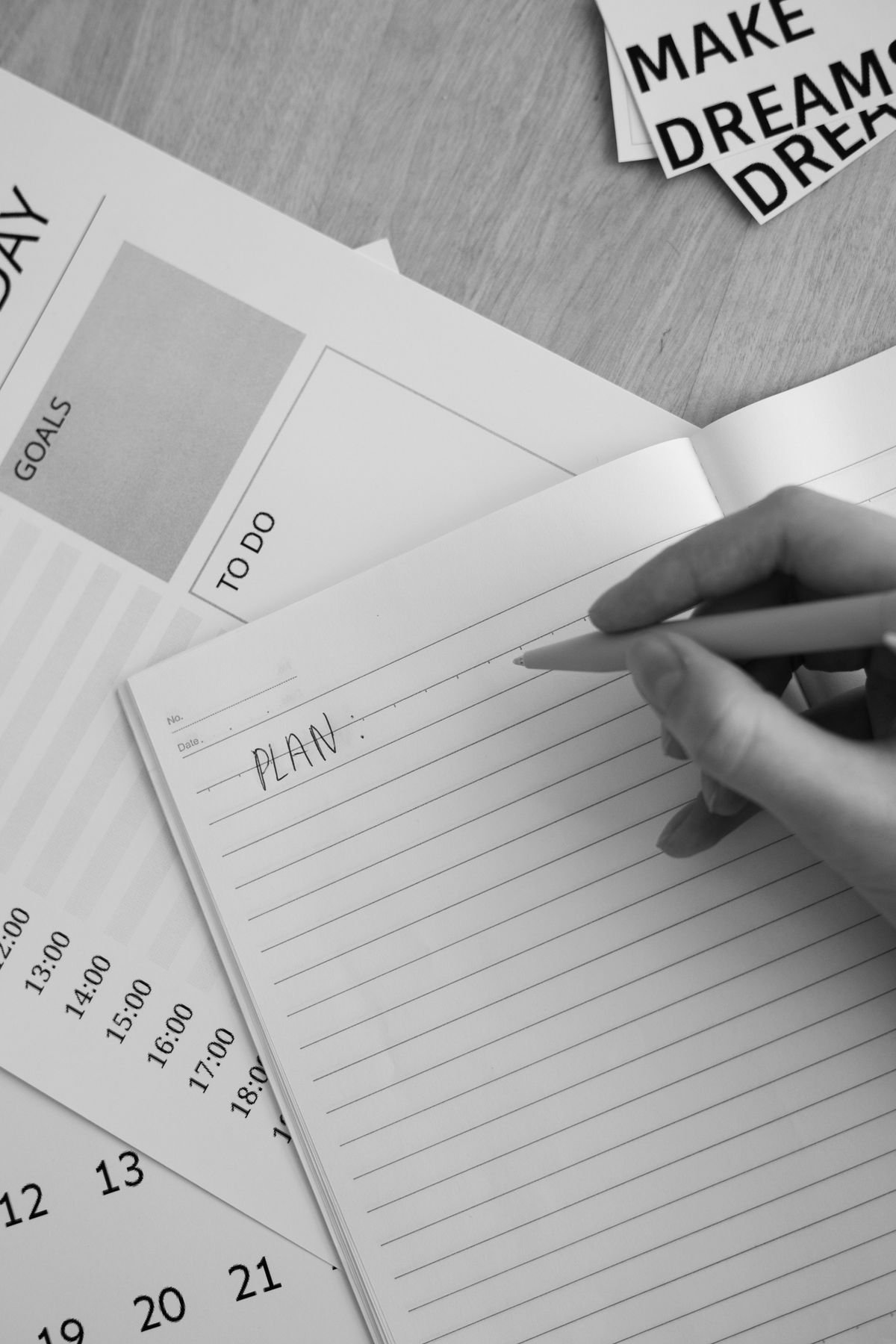
Do not worry about duplicates or overlapping items at this stage. A brain dump is supposed to be messy. If you think of a task while you are doing something else, add it to the list immediately rather than trusting yourself to remember it later. Many people use a notes app or a paper notebook for this stage because it is fast and always nearby. The important thing is that the list holds the tasks so your mind does not have to. When you feel the list is complete, read it once through and cross out anything that is not actually needed for this goal. What remains is the raw material for your plan.
Step 3: Break Big Tasks Into Small Actions
Now take each large item and break it into actions that take between fifteen minutes and two hours. This is the most important step in the whole process, and the one most people skip. A task is ready for your list when you can start it immediately without having to work out what it means. Write the report is not ready, because it leaves too many questions unanswered: which report, what data, how long should it be, and who needs to approve it? Gather last quarter’s sales figures from the shared drive is ready. Draft the three main findings in bullet points is ready. Send the draft to Sara for comments by Thursday is ready. Each of these is a single, concrete action with a clear end point.
Use a simple test for every item: could another person understand what to do from the wording alone, and would they know when it is finished? If the answer is no, break it down further. Use action verbs at the start of each task, such as call, draft, book, measure, send, or review, instead of vague nouns. A good rule is that if a task will take longer than two hours, it is really a small project, and it needs to be split. If a task will take less than two minutes, do it now rather than writing it down. This breaking-down step is what makes a list feel achievable. Instead of one mountain, you see a set of small steps, and each completed step gives you a small win that builds momentum for the next one.
Step 4: Prioritise What Matters Most
With a list of small actions, the next step is to decide what matters most. Not everything on the list is equal, even if it all feels urgent. The Eisenhower Matrix is a simple way to sort tasks into four groups: urgent and important, important but not urgent, urgent but not important, and neither urgent nor important. Do the urgent and important tasks first. Schedule the important but not urgent ones, because these are the tasks that actually move long-term goals forward, such as studying, exercising, or planning. Delegate the urgent but not important tasks where you can, and delete or postpone the tasks that are neither urgent nor important. This single exercise can cut a long list down to a manageable size.

Another useful method is MoSCoW, which sorts tasks into Must have, Should have, Could have, and Will not have this time. This method is popular in project planning because it forces honest choices. If everything is a must have, nothing is. Try limiting your must have tasks to three per day. Three important tasks, finished well, will move a goal further than twelve half-finished ones. Also consider the order of energy, not just importance. Put your hardest and most important task first in the day, when your focus is strongest, and save routine tasks, such as filing or replying to routine emails, for later in the day when your energy is lower. Prioritising is not about doing more. It is about doing the right things first.
Step 5: Put Tasks in the Right Order
After prioritising, arrange the tasks in the order they must happen. Some tasks depend on others: you cannot print the invitations until the guest list is final, and you cannot finalise the guest list until the venue capacity is confirmed. These are called dependencies, and missing one can stall the whole goal. Go through your list and mark each task as either a starter task, which has no dependencies and can begin now, a dependent task, which needs another task finished first, or a waiting task, which needs someone else to act. Number the tasks in the order you will do them, and if a task depends on another, write the number of the task it depends on next to it, so the sequence is clear at a glance.
Grouping similar tasks together can also save time. This is called batching. For example, make all your phone calls in one block, do all your writing in another, and handle all your errands in a single trip. Switching between different kinds of work has a real cost: research on attention shows that every switch costs time and focus. A well-ordered list reduces switching, because it lets you see which similar tasks can be done together. When the order is clear, the list stops being a set of competing demands and starts being a route you can follow from start to finish.
Step 6: Schedule Each Task and Set Deadlines
A task without a time is only a wish. Take your ordered list and give each task a specific time or deadline. Start with the goal deadline and work backwards. If the goal is due on 1 June, and the last task takes a week, that task must start by 25 May. If an earlier task takes three days, it must start by 22 May, and so on. Working backwards like this reveals whether your plan is realistic. If the backwards schedule shows that you would have needed to start last month, the goal deadline or the scope of the goal needs to change. It is far better to discover that now, on paper, than two days before the deadline.

Use time blocking where you can: put the task in your calendar as an appointment with yourself, not just as a line on a list. Add a realistic time estimate next to each task, and then add a buffer of about twenty-five percent, because tasks almost always take longer than we expect. If you think a task will take an hour, block ninety minutes. That buffer protects the rest of the day when one task runs long. Also set a start time, not only a due date. Due dates tell you when a task must be finished, but start dates tell you when to begin, and beginning is usually the hardest part. A list with dates, times, and buffers is a plan you can actually live by.
Step 7: Review, Track, and Adjust Every Day
A task list is a living document, not a one-time creation. Review it briefly at the end of each day and more thoroughly once a week. In the daily review, tick off what you finished, carry forward what you did not, and choose the top three tasks for tomorrow. This takes five minutes and means you never start the day wondering what to do. In the weekly review, ask bigger questions: Is the goal still the right goal? Has anything changed? Are some tasks no longer needed? Should the order or the deadlines change? A weekly review is also the time to celebrate progress. Count the completed tasks, note how much closer you are to the goal, and give yourself credit for the work done. That sense of progress is one of the strongest motivators there is.
Tracking also helps you learn how you work. If you keep a simple record of how long tasks actually took, your estimates will get better over time, and your future lists will be more accurate. If a task keeps being carried forward day after day, do not just copy it again. Ask why it is stuck: Is it too big? Does it need information from someone else? Are you avoiding it because it is unpleasant? Break it down, delegate it, or schedule a specific time to do the first small part of it. A task that stays on a list for weeks is a signal, not a failure, and the review is where you listen to that signal.
Tools and Templates That Help
You do not need expensive software to make an effective task list. A notebook, a whiteboard, or a simple notes app is enough for most personal goals. For shared goals, a shared list in an app such as Google Tasks, Microsoft To Do, Todoist, or Trello helps everyone see what is assigned to whom and what is done. A paper planner works well if you like writing by hand and crossing items off with a pen, which many people find satisfying. The best tool is the one you will actually open every day. If you choose an app, keep it simple: use one list for the goal, one place for the schedule, and one daily review habit. Adding more tools does not make the plan better; using one tool consistently does.
A simple template can help you start. For each task, write the task in action words, the person responsible, the priority (high, medium, or low), the start date, the due date, and the done test, which is how you will know it is finished. Keep this template somewhere you can copy it for every new goal. The template removes the need to reinvent the process each time, so you can spend your energy on the work itself. Many people also keep a second list, a parking lot, for ideas that are not part of the current goal. When a new idea arrives, park it there instead of letting it distract you from the list you are working on.
Worked Example: Planning a Small Online Shop
Here is the whole process in one example. Suppose your goal is to launch a small online shop selling handmade candles by 1 December 2026. First, write the goal in SMART form: List ten candle products for sale on an online shop and take the first order by 1 December 2026. Next, brain dump everything: choose a shop name, check the name is available, photograph the candles, write product descriptions, set prices, work out delivery costs, open a business bank account, design a logo, create social media accounts, and ask three friends to test the website. Then break the big items down: photograph the candles becomes set up the table and lights, photograph each candle from three angles, and choose the best photo for each product.
Next, prioritise. The must haves are the products, the photos, the prices, and a working checkout. The logo and social media accounts are important but can be simple at first. Ordering is next: the photos depend on the products being ready, the descriptions depend on the photos, and the shop cannot open until the checkout works. Schedule backwards from 1 December: the checkout must be tested by 24 November, the products must be listed by 20 November, and the photos must be finished by 15 November. Finally, review daily: each evening, tick off the finished tasks and choose the next three. By the launch date, the list has become the business plan, one small finished task at a time.
Common Mistakes to Avoid
The most common mistake is making the list too long. A list with thirty tasks for one day is not a plan, it is a wish. Keep the daily list to three to five important tasks plus a few small ones. The second mistake is writing tasks that are actually goals, such as get a new job, instead of actions, such as update the CV and apply for two roles. The third mistake is never removing completed or cancelled tasks, which makes the list look longer than it is and hides your progress. The fourth mistake is keeping the list in several places at once: some tasks in an app, some in a notebook, some in your head. Choose one place and keep everything there. Finally, do not confuse being busy with making progress. A day full of small, easy tasks can feel productive while the important work stays untouched. Judge the day by whether the top three tasks got done, not by how many items you ticked off.
Frequently Asked Questions
How many tasks should be on a daily list?
Aim for three important tasks and a small number of quick tasks. Research and practical experience both point the same way: a short list you finish is better than a long list you abandon. If you finish the three important tasks early, you can always add more, but starting the day with a list you cannot finish sets you up to fail.
What is the best way to prioritise tasks?
Start with the Eisenhower Matrix or MoSCoW method, described above. Both force you to separate what is important from what only feels urgent. For a single day, ask a simpler question: if I could only finish one task today, which one would move the goal forward most? Do that one first.
Should I use paper or an app for my task list?
Use whichever you will check every day. Paper is simple, visible, and satisfying to cross off. Apps are better for reminders, shared lists, and tasks that repeat. Many people use both: paper for the daily top three and an app for the full project list. The method matters far less than the daily habit of using it.
How often should I review my task list?
Review it for five minutes at the end of each day and for twenty minutes once a week. The daily review keeps the list current. The weekly review keeps the goal on track, catches tasks that are stuck, and lets you adjust dates and priorities before small problems become missed deadlines.
Conclusion
To explain the process of creating an effective list of tasks to accomplish a goal, remember the seven steps: define the goal clearly, write down everything that comes to mind, break big tasks into small actions, prioritise what matters most, put the tasks in the right order, give each one a time and a deadline, and review the list every day. A task list built this way is more than a reminder. It is a clear, honest plan that turns a distant goal into work you can do today. Start with one goal, write it down, and build your first list using these steps. By the end of the week, you will not only have a better list, you will have proof that the process works: finished tasks, visible progress, and a goal that is measurably closer than it was yesterday.
 asad_writer
 DIGITAL EMPIRE AGENCY