
Introduction
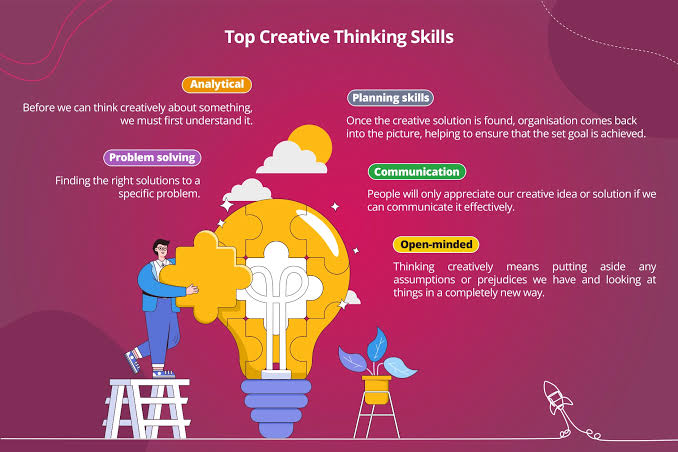
Creative thinking is not limited to artists, designers, or professional writers. It is a valuable ability that helps people discover new possibilities, solve everyday problems, and approach familiar situations from different perspectives.
From organizing a household to developing a business idea, creativity encourages individuals to move beyond automatic responses and consider alternative solutions.
Although some people naturally enjoy imaginative activities, creative thinking can also be developed through practice. Curiosity, observation, experimentation, and continuous learning all contribute to stronger creative abilities.
What Is Creative Thinking?
Creative thinking involves generating original ideas and finding useful connections between information, experiences, and observations.
It does not necessarily mean inventing something completely new. Sometimes creativity involves improving an existing process, combining two familiar ideas, or finding a simpler way to complete a task.
For example, a student may create a visual study schedule to understand difficult lessons more effectively. A small business owner might introduce a different customer service approach to improve satisfaction.
Both examples demonstrate practical creativity because they involve finding better ways to address existing needs.
Develop Curiosity Through Observation
Curiosity is one of the strongest foundations of creativity. People become more imaginative when they actively explore their surroundings and ask questions about how things work.
Instead of accepting every situation without thinking, curious individuals look for explanations and possible improvements.
Reading different types of books, visiting unfamiliar places, learning about other cultures, and speaking with people from different backgrounds can introduce new ideas.
Observation is equally valuable. Everyday experiences often contain opportunities for creative thinking that people overlook because they are focused on routine responsibilities.
Keeping a notebook for interesting ideas can help preserve useful observations before they are forgotten.
Explore Different Sources of Inspiration
Creative inspiration can come from many places. Nature, architecture, music, photography, history, technology, and personal experiences can all encourage fresh thinking.
Writers, for instance, may discover interesting story ideas through ordinary conversations or unexpected events.
Visual artists might find inspiration in natural colors, unusual shapes, or the design of everyday objects.
Exploring different forms of language can also strengthen creativity. A broader vocabulary allows people to communicate descriptions more effectively and experiment with different writing styles.
One helpful exercise is to study descriptive language and practice using unfamiliar expressions in original sentences. A collection of words that can enrich descriptive writing can provide useful inspiration for this activity.
Avoid Limiting Ideas Too Early
One common obstacle to creativity is judging ideas before they have been fully explored.
People sometimes reject possibilities because they seem unusual, difficult, or unrealistic. While practical evaluation is necessary eventually, criticizing every suggestion during the initial brainstorming stage can prevent useful ideas from developing.
A better approach is to generate several possibilities before selecting the strongest ones.
For example, someone planning a community event could write down ten different activities before deciding which options fit the available budget and space.
This process creates more opportunities for unexpected solutions.
Use Brainstorming Effectively
Brainstorming is a simple technique for producing multiple ideas around a particular challenge.
Start by identifying the problem clearly. Then write down possible solutions without immediately deciding whether each one is perfect.
After generating enough suggestions, review them according to usefulness, cost, time, and available resources.
Brainstorming can be completed individually or with a group. Group discussions are especially useful because participants bring different experiences and perspectives.
However, everyone should have an opportunity to contribute. A supportive environment encourages people to share unusual suggestions without worrying about immediate criticism.
Learn Through Experimentation
Creative thinking becomes stronger when people test their ideas.
An idea may sound excellent in theory but produce unexpected results when applied in real situations. Experimentation helps identify weaknesses and reveals opportunities for improvement.
For example, a business owner testing a new product presentation could compare customer reactions before making a larger investment.
A student experimenting with different learning methods may discover that diagrams and practical examples work better than memorizing long paragraphs.
The important lesson is that experimentation should be treated as a learning opportunity rather than a demand for immediate perfection.
Make Room for Independent Thinking
Constant exposure to information can sometimes make it difficult to develop original thoughts. Taking time away from distractions can help individuals reflect and connect ideas.
Walking, writing personal notes, reading quietly, or spending time in nature may provide opportunities for independent thinking.
It is also useful to question assumptions. A process that has always been completed in one particular way may have room for improvement.
Independent thinking does not mean ignoring expert advice. Instead, it involves considering information carefully and making informed decisions.
Apply Creativity to Everyday Life
Creativity can improve many ordinary activities.
At home, people can organize limited spaces more efficiently. In education, students can create memorable learning materials. At work, employees can suggest ways to simplify repetitive tasks.
Creative approaches can also improve communication. Choosing better examples, clearer explanations, and more engaging presentations helps people share information effectively.
Small improvements often have practical value because they save time, reduce frustration, or make experiences more enjoyable.
Conclusion
Creative thinking is a practical ability that supports learning, innovation, and everyday problem-solving. It grows through curiosity, observation, experimentation, and a willingness to consider different perspectives.
People do not need extraordinary talent to become more creative. They simply need opportunities to explore ideas, question assumptions, and learn from experience.
By making creativity part of everyday routines, individuals can discover better solutions and approach challenges with greater confidence.
 asad_writer
 DIGITAL EMPIRE AGENCY