
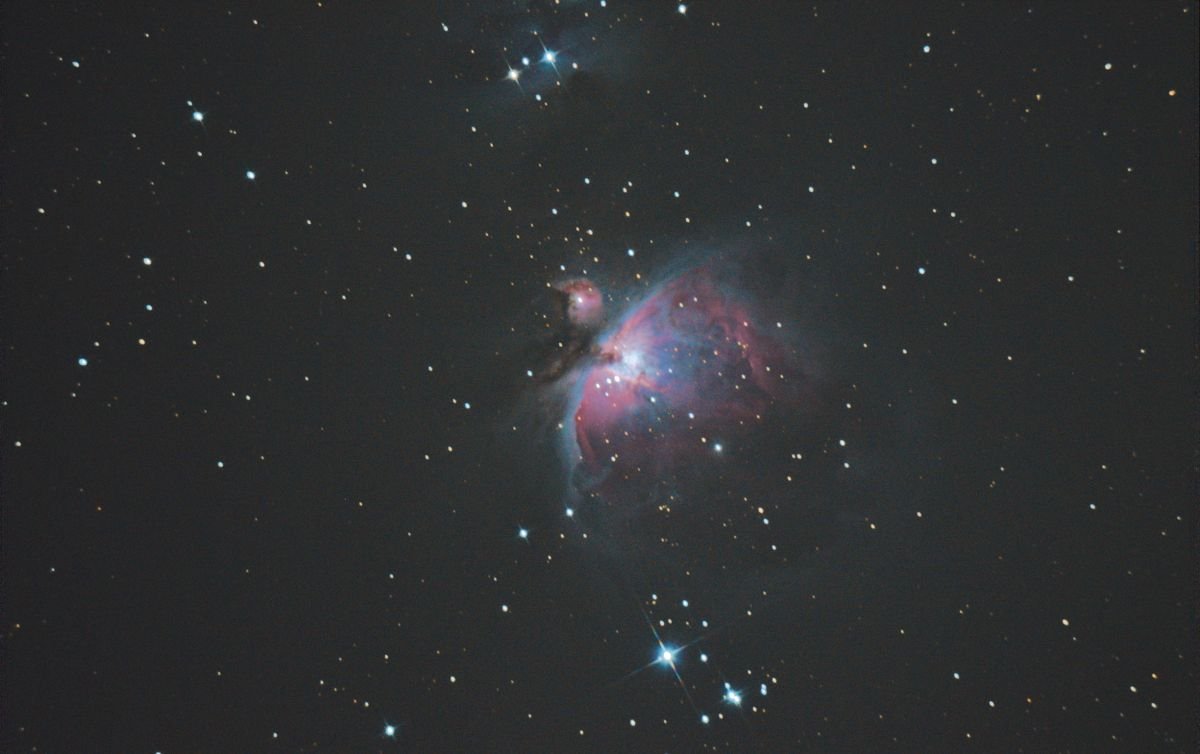
Show a Herbig-Haro and how they are photographed: a Herbig-Haro object is a glowing patch of gas and dust in space, lit up where a jet from a newborn star slams into the cloud around it. These objects are some of the most striking things in astronomy, narrow jets, bright knots, and sweeping bow shocks that look like cosmic fireworks. This article shows you what Herbig-Haro objects look like, explains how they form, and walks through exactly how telescopes photograph them, from the James Webb Space Telescope’s infrared cameras to the narrowband filters amateur astrophotographers use at home.
Herbig-Haro objects, usually shortened to HH objects, are named after the two astronomers who first studied them in detail in the 1940s and 1950s: George Herbig in the United States and Guillermo Haro in Mexico. They are not stars and not nebulae in the usual sense. They are the glowing aftermath of a collision: a newborn star fires a narrow jet of gas outward at hundreds of kilometers per second, and where that jet hits the surrounding cloud, the gas heats up and glows. The result is a small, bright, often beautifully shaped patch of light in the dark.
What Is a Herbig-Haro Object?
A Herbig-Haro object is a small, luminous patch of nebulosity associated with a newborn star, called a protostar. When a star is forming, it pulls in gas from a disk around it, and some of that gas is ejected along the star’s poles in a narrow, high-speed jet. The jet travels outward at 100 to 500 kilometers per second, far faster than the speed of sound in the surrounding cloud, and when it crashes into that cloud it creates a shock wave. The shock heats the gas to thousands of degrees, and the hot gas glows in specific wavelengths of light, mostly the red light of hydrogen and the light of ionized sulfur.
HH objects are short-lived on cosmic timescales, typically lasting only a few thousand years, a blink of an eye in astronomy. They are also small: a typical HH object is a fraction of a light-year across, though the jets that create them can stretch for more than a light-year. More than 400 HH objects have been cataloged, and new ones are still being found, especially in nearby star-forming regions like Orion, Taurus, and Chamaeleon. They matter because they are direct evidence of how stars are born, and because their shapes reveal the history of the jet that made them, like footprints showing where a star has been.
How Herbig-Haro Objects Form
Star formation begins in a cold, dark cloud of gas and dust. Gravity pulls part of the cloud together until it collapses into a protostar, a baby star that is still gathering mass. As gas spirals inward through a disk, magnetic fields channel some of it outward again, firing twin jets along the disk’s axis. These jets are the star’s exhaust, and they carry away angular momentum so the star can keep growing. Where the jet meets the surrounding cloud, a shock front forms, and the shocked gas glows. That glowing patch is the Herbig-Haro object. Often the jet produces a series of knots along its path, like beads on a string, each one marking a past burst of activity from the young star.
The jets are not steady. Young stars are variable, and their jets pulse: a burst of fast gas catches up with slower gas ahead of it, creating a shock, a bow-shaped glowing arc that points away from the star. That is why HH images often show graceful arcs and curved filaments, the bow shocks of successive pulses. Over thousands of years, the jet may also change direction slightly as the disk wobbles, and that wobble is recorded in the curved path of the HH knots, a fossil record of the young star’s early life.
Famous Herbig-Haro Objects You Can See
Some Herbig-Haro objects have become famous because of the images telescopes have made of them. Herbig-Haro 49/50, photographed by the James Webb Space Telescope in March 2025, is a jet from a nearby still-forming star that looks like a cosmic tornado, a curved, glowing structure captured in near- and mid-infrared light by Webb’s NIRCam and MIRI cameras. You can see the official image on the ESA/Webb and NASA Science websites, where it was released as a composite of several exposures.
Herbig-Haro 46/47, imaged by Webb in July 2023, shows a pair of actively forming stars and their jets, and its composite NIRCam image is one of the clearest portraits of a young star system ever made. Herbig-Haro 211, also photographed by Webb, is a bipolar jet from a protostar that resembles a young Sun, and it shows the fine structure of the jet in infrared light. Herbig-Haro 111, in the Orion constellation, is a classic Hubble target: a long, straight jet with bright knots that looks like a stream of glowing beads.
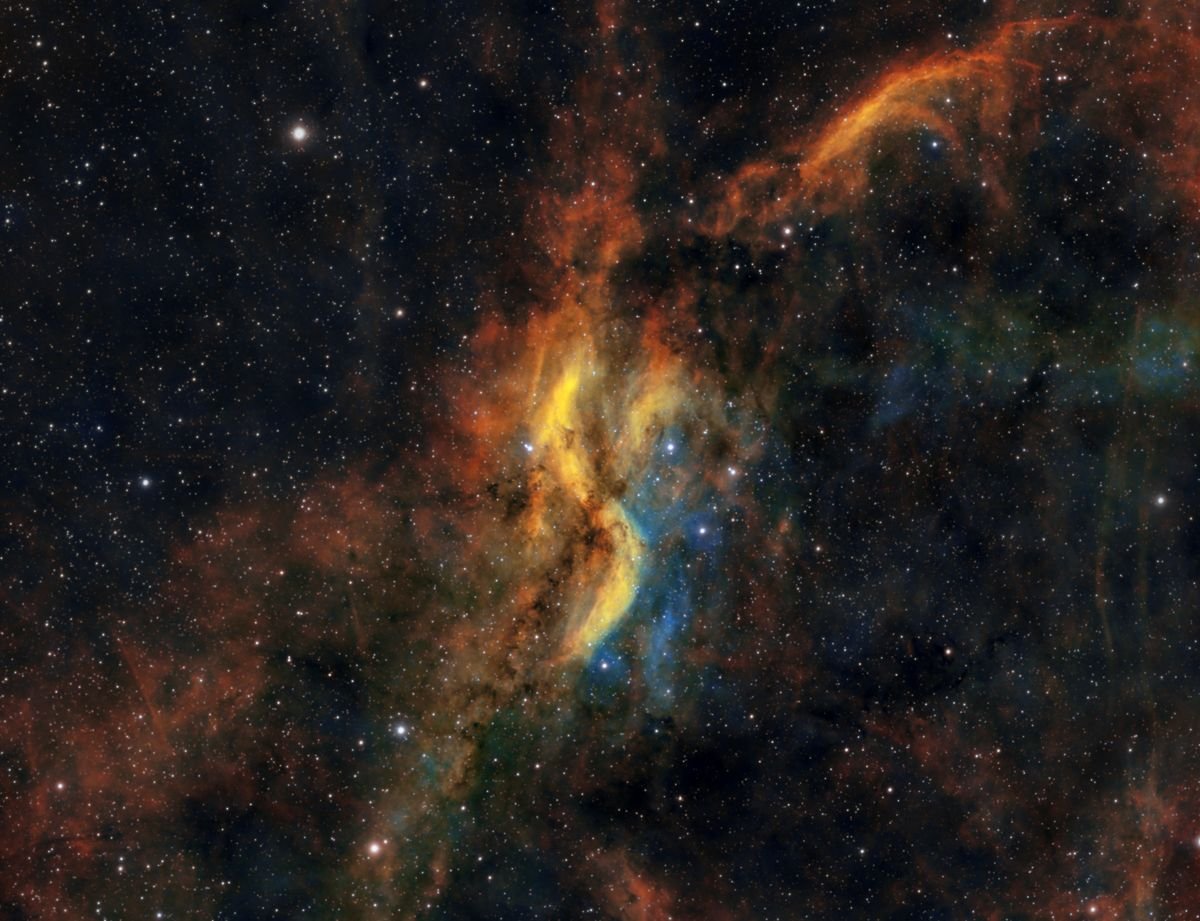
The photo above shows the Orion Nebula, the vast star-forming region where many Herbig-Haro objects live. The actual Herbig-Haro photographs are made by space telescopes and are published by NASA and ESA. If you want to see them directly, search for HH 49/50, HH 46/47, HH 211, and HH 111 on the NASA Science and ESA/Webb image galleries, where the full-resolution versions are free to view and download.
How Herbig-Haro Objects Are Photographed
Photographing a Herbig-Haro object is a challenge of light, distance, and dust. HH objects are faint, small, and often hidden inside dusty clouds that block visible light. Photographers solve this with three tools: the right telescope, the right filters, and long exposures.
First, the telescope. The Hubble Space Telescope photographed HH objects in visible light for decades, and its images of HH 111 and HH 34 are classics. The James Webb Space Telescope changed the game because it sees in infrared light, which passes through dust. Webb’s NIRCam camera takes near-infrared images that reveal the jets and the protostars hidden inside the dust, while its MIRI camera takes mid-infrared images that show the cooler dust and the structure of the surrounding cloud. A single published Webb image is a composite of both cameras, several exposures, and multiple filters, combined by scientists into one picture.
Second, the filters. HH objects glow mostly in a few specific wavelengths: the red light of hydrogen (H-alpha) and the light of ionized sulfur, known as [S II]. Astronomers use narrowband filters that let through only those wavelengths and block everything else, which makes the faint jets stand out against the sky. This is why HH photographs often look red and pink. The colors in published images are real data, but they are mapped to colors we can see: infrared light, which is invisible to our eyes, is assigned a visible color, usually red, orange, or blue, so the structure of the object can be seen.
Third, the exposure. HH objects are faint, so a single short exposure shows almost nothing. Photographers take many long exposures, sometimes minutes each, and stack them together. Stacking adds up the light from the object while averaging out the noise, which is how a faint jet becomes a clear image. Professional observatories do the same thing at a larger scale: a published Hubble or Webb image may combine hours of total exposure time, captured over many separate frames and then aligned and combined by software.
Tracking matters as much as exposure. The sky moves as the Earth rotates, so any long exposure needs a mount that follows the stars, or the image will smear. Space telescopes do not have this problem, but ground-based photographers do, and it is why a tracking mount and a good polar alignment are the foundation of astrophotography. Focus is critical too: a slightly out-of-focus star ruins a faint object that is already on the edge of visibility.

Can You Photograph a Herbig-Haro Object Yourself?
Yes, with the right equipment and patience, an advanced amateur can photograph bright HH objects. The best targets are HH 34 in Orion and HH 111, also in Orion, because they are relatively bright and well placed in the winter sky. You will need a telescope with a focal length of 600 millimeters or more, an equatorial tracking mount, a cooled astronomy camera or a modified DSLR, and narrowband filters for hydrogen-alpha and sulfur-II. Plan on several hours of total exposure, taken as many short frames and stacked in software like DeepSkyStacker or PixInsight.
Manage your expectations honestly. An amateur photo of an HH object will show a small, faint, red knot or jet, not a Hubble-quality image. The joy is in capturing something real: a jet from a star that is still being born, hundreds of light-years away, with your own telescope. For most people, the best way to see HH objects is to look at the Hubble and Webb images online, and to visit a local astronomy club’s star party, where experienced astrophotographers can show you their own images and their equipment.
| Telescope | What it sees | Best for |
|---|---|---|
| Hubble Space Telescope | Visible and near-ultraviolet light | Classic HH images like HH 111 and HH 34 |
| James Webb Space Telescope | Near- and mid-infrared light | Jets hidden inside dust, like HH 49/50 and HH 211 |
| Ground-based telescopes | Visible light through the atmosphere | Wide-field views and long-term monitoring |
| Amateur setups | Narrowband hydrogen and sulfur light | Bright HH objects like HH 34 and HH 111 |
Frequently Asked Questions
What does a Herbig-Haro object look like?
It looks like a small, glowing patch of gas, often shaped like a knot, a jet, or a curved bow shock. In telescope photographs it usually appears red or pink, because it glows mostly in the red light of hydrogen and ionized sulfur, and it is often found near a newborn star that is hidden inside a dark cloud of dust.
Why are Herbig-Haro objects photographed in infrared?
Infrared light passes through the dust clouds that hide newborn stars, while visible light is blocked. The James Webb Space Telescope’s infrared cameras can see the jets and the young stars inside the dust, which is why its HH images are so much more detailed than the visible-light images that came before them.
Are the colors in Webb telescope images real?
The colors are real data, mapped to colors we can see. Webb records infrared light that is invisible to human eyes, and scientists assign visible colors to different infrared wavelengths so the structure becomes visible. The brightness and shapes are genuine, and the color mapping is documented in each image release.
How long do Herbig-Haro objects last?
Only a few thousand years, which is very short in astronomy. The jets that create them fade as the young star stops ejecting gas, and the glowing knots disperse into the surrounding cloud. That is why HH objects are always found near very young stars.
Conclusion
Show a Herbig-Haro and how they are photographed, in one line: a Herbig-Haro object is the glowing shock wave where a newborn star’s jet hits the cloud around it, and it is photographed with infrared cameras, narrowband filters, and long stacked exposures that turn a faint wisp of gas into a famous image. The best views come from the James Webb Space Telescope, whose infrared cameras see through the dust that hides young stars, and whose images of HH 49/50, HH 46/47, and HH 211 are free to explore on the NASA Science and ESA/Webb websites. The next time you see a swirling, colorful image of a star being born, look for the narrow jets and glowing knots: that is a Herbig-Haro object, and it is the youngest, most dramatic moment in a star’s life, caught on camera.