
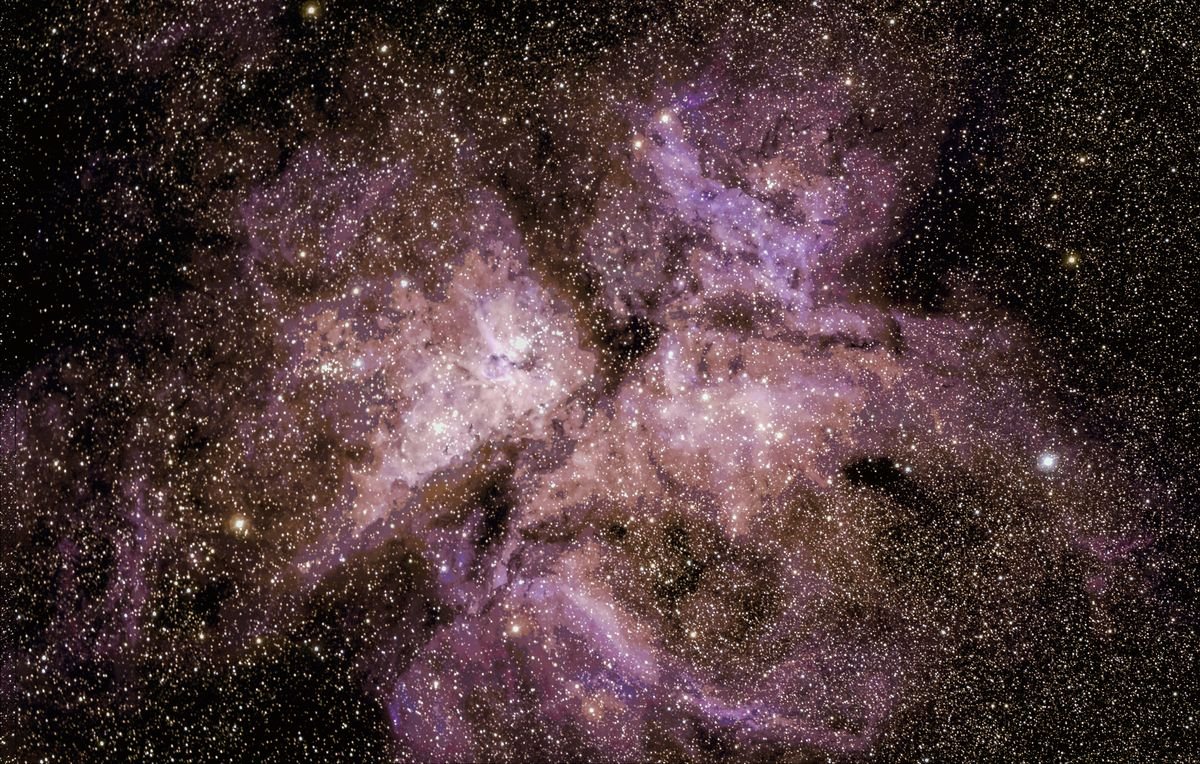
Show the Carina Nebula and how it’s photographed: the Carina Nebula is one of the largest and most spectacular star-forming regions in the sky, a vast cloud of gas and dust about 7,600 light-years away in the southern constellation Carina. Its most famous photograph, the James Webb Space Telescope’s Cosmic Cliffs image from July 2022, looks like craggy mountains on a moonlit evening. This article shows you what the Carina Nebula looks like, explains the stars and structures inside it, and walks through exactly how telescopes photograph it, from Webb’s infrared cameras to the narrowband filters amateur astrophotographers use.
The Carina Nebula, cataloged as NGC 3372, is one of the brightest nebulae in the sky, though it is only visible from the Southern Hemisphere and from low northern latitudes. It spans more than 300 light-years, which makes it about four times the size of the Orion Nebula, and it contains some of the most massive and luminous stars known. Where the Orion Nebula is a nursery, the Carina Nebula is a whole city of star formation, with clouds, pillars, and clusters that have been studied for two centuries.
What Is the Carina Nebula?
The Carina Nebula is an emission nebula, a cloud of hydrogen gas that glows because it is energized by the young, hot stars inside it. Those stars flood the cloud with ultraviolet light, which strips electrons from hydrogen atoms, and when the electrons recombine, the gas glows red. That red glow is the nebula’s signature color in visible-light photographs. The cloud also contains dark lanes of dust, which block the light behind them and create the dramatic silhouettes that make Carina photographs so striking.
The nebula is a stellar nursery on a grand scale. Hundreds of stars are forming inside it, and its most famous residents are its most extreme. Eta Carinae, the brightest star in the nebula, is a binary system with a combined mass of more than 100 Suns, and it is one of the most luminous stars in the Milky Way. In the 1840s it underwent the Great Eruption, briefly becoming the second-brightest star in the sky, and it ejected the Homunculus Nebula, a bipolar cloud of gas that still surrounds it. Eta Carinae is expected to explode as a supernova someday, though when that will happen is anyone’s guess.
The Landmarks Inside Carina: Cosmic Cliffs, the Keyhole, and Mystic Mountain
The Carina Nebula has several famous landmarks, and each one is a different kind of structure. The Cosmic Cliffs are the edge of a giant, gaseous cavity about seven light-years high, carved by the ultraviolet radiation and stellar winds of young, massive stars. In Webb’s 2022 image, the cliffs look like mountains, with hundreds of stars visible above and below them, and the steam-like wisps are actually streams of hot gas. The image was one of Webb’s very first science images, released on July 12, 2022, and it became an instant icon.
The Keyhole Nebula is a dark, keyhole-shaped cloud of cold molecules and dust near Eta Carinae, and it is one of the most photographed features of the nebula. The Mystic Mountain is a three-light-year-tall pillar of gas and dust photographed by Hubble in 2010, a towering column where new stars are forming at its tip. The bright region near the center is dominated by Trumpler 14 and Trumpler 16, two young open star clusters whose massive stars are the engines of the whole nebula, sculpting the gas with their light and winds.
How the Carina Nebula Is Photographed
Photographing the Carina Nebula takes the same three ingredients as any deep-sky image, the right telescope, the right filters, and long exposures, but Carina adds a twist: it is so large and so bright that it has been photographed by almost every major telescope ever built, and each one sees it differently. Comparing those images is a tour through the history of astronomy.
The Hubble Space Telescope photographed Carina in visible light, and its 2010 image of the Mystic Mountain pillar is one of the most famous Hubble images ever released. Hubble sees the red glow of hydrogen and the dark dust lanes in sharp detail, and its images show the pillars and filaments sculpted by the young stars. The James Webb Space Telescope photographs Carina in infrared light, which passes through the dust. Webb’s NIRCam camera took the Cosmic Cliffs image, revealing hundreds of stars that were hidden behind dust in Hubble’s view, and its MIRI camera takes mid-infrared images that show the cooler dust and the structure of the cloud itself.
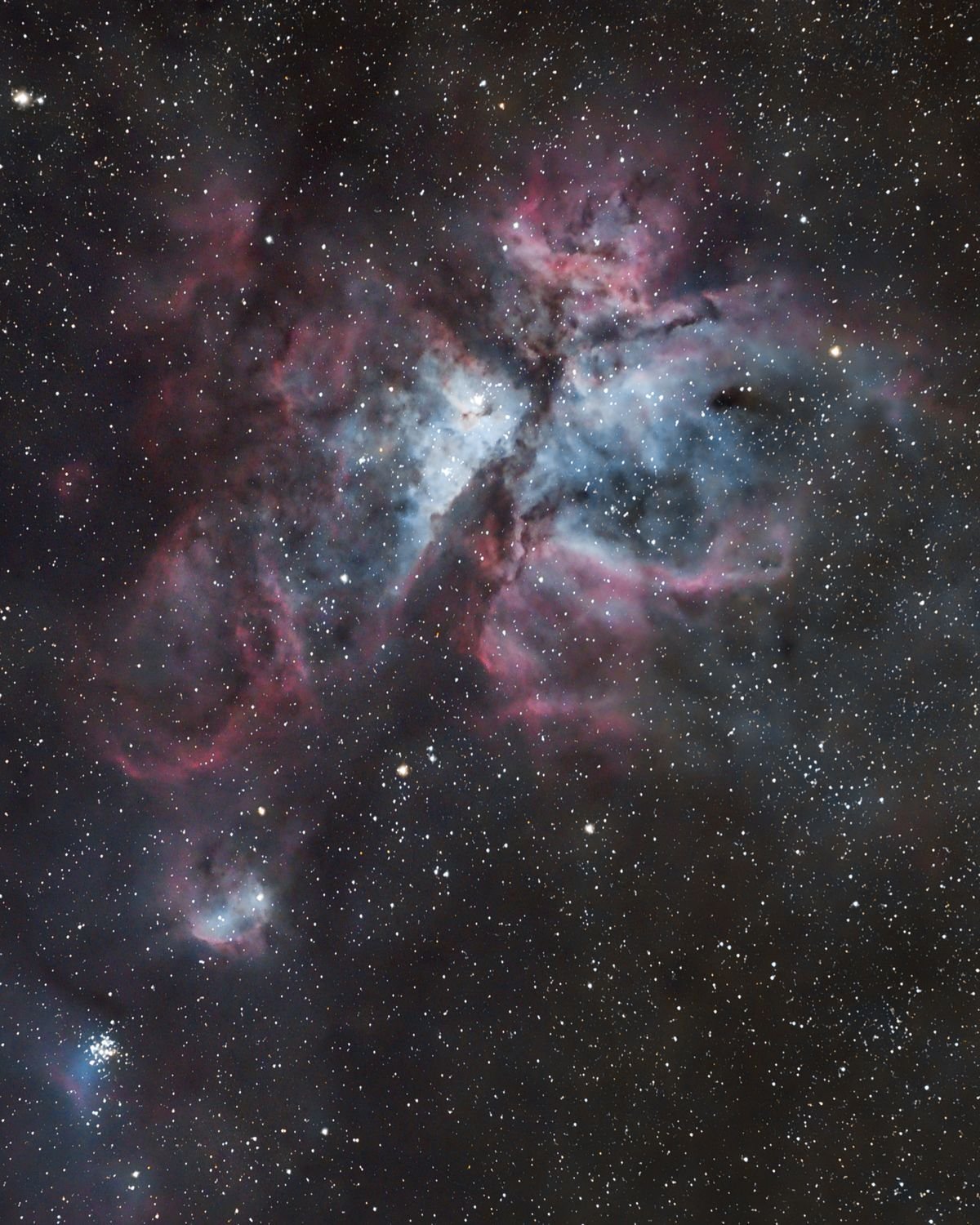
The photo above shows a Carina Nebula image with the rich colors of a long-exposure deep-sky photograph: the red glow of hydrogen, the dark dust lanes, and the dense star fields. The famous Cosmic Cliffs photograph is a different image, made by the James Webb Space Telescope, and it is published by NASA and ESA. If you want to see it directly, search for Cosmic Cliffs in the Carina Nebula on the NASA Science and ESA/Webb image galleries, where the full-resolution version is free to view and download.
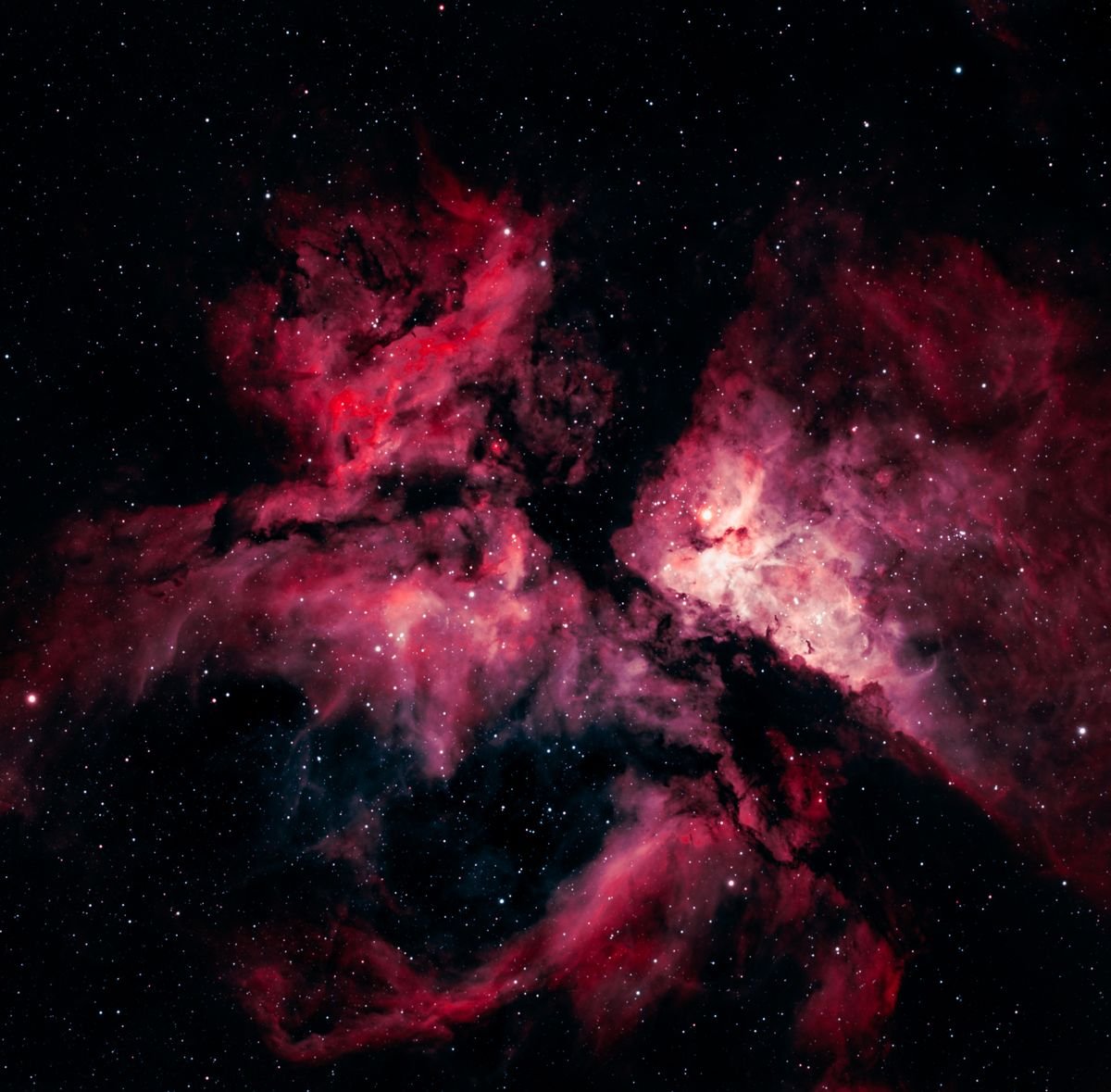
Filters are the second ingredient. Narrowband filters let through only the light of a specific element, hydrogen-alpha for red, oxygen-III for blue-green, sulfur-II for deep red, and block everything else. When photographers combine images taken through three different filters, they assign each one a color, a technique called the Hubble palette, and the result is the vivid, multicolored look of many nebula photographs. The colors are real data, mapped to colors we can see, which is why the same nebula can look different in two photographs made with different filters.
The third ingredient is exposure time. A single short exposure of Carina shows a faint smudge. A photograph made from hours of total exposure, collected as many shorter frames and stacked, reveals the pillars, filaments, and faint outer clouds. Stacking adds up the light while averaging out the noise, and it is the reason amateur photographs of Carina can look spectacular even with modest equipment.
| Telescope | What it sees | Famous Carina image |
|---|---|---|
| Hubble Space Telescope | Visible and ultraviolet light | Mystic Mountain, 2010 |
| James Webb Space Telescope | Near- and mid-infrared light | Cosmic Cliffs, 2022 |
| Ground-based telescopes | Visible light through the atmosphere | Wide-field views of the whole nebula |
| Amateur setups | Narrowband hydrogen and oxygen light | Color images of the pillars and Keyhole |
Can You Photograph the Carina Nebula Yourself?
Yes, if you are in the Southern Hemisphere, or far enough south that Carina rises above your horizon. The nebula is a southern object: it is best seen from latitudes south of about 30 degrees south, including Australia, New Zealand, South Africa, and Chile, where it passes high overhead in autumn. From the southern United States, Florida, and Hawaii, it is a low, challenging target near the horizon. From northern Europe or Canada, it never rises at all.
For amateur photographers, Carina is generous. It is bright, large, and full of color, which makes it one of the best first targets in the southern sky. A telescope or camera lens of 200 to 400 millimeters, an equatorial tracking mount, and a few hours of exposure through hydrogen-alpha and oxygen-III filters will produce a beautiful image of the pillars and the Keyhole. A modified DSLR or a dedicated astronomy camera, narrowband filters, and stacking software are the standard toolkit. As with all astrophotography, a dark sky and a stable mount matter more than an expensive telescope.

Where to See the Best Carina Nebula Photographs
The best Carina images are free and public. The James Webb Space Telescope’s Cosmic Cliffs image is on the NASA Science website and the ESA/Webb image gallery, in full resolution and free to download. NASA also published a 3D exploration of the Cosmic Cliffs in May 2025, a scientific visualization that flies through the nebula and shows its structure in three dimensions. Hubble’s Mystic Mountain is on the ESA/Hubble and NASA Hubble image galleries. The European Southern Observatory has wide-field images from its ground-based telescopes in Chile, including the VLT Survey Telescope’s 2012 panorama that shows the full nebula in one frame.
For a sense of scale, try this. The Cosmic Cliffs in Webb’s image are about seven light-years tall. If you could fly across them at the speed of a commercial jet, the trip would take about 7 million years. The whole Carina Nebula spans more than 300 light-years, and the light in the photographs left the nebula around 7,600 years ago, when humans were first inventing farming. Looking at Carina is looking back in time, and photographing it is a way of capturing a moment in a story that has been unfolding for thousands of years.
Frequently Asked Questions
How far away is the Carina Nebula?
About 7,600 light-years from Earth, in the southern constellation Carina. The light in its photographs left the nebula around 7,600 years ago, and the nebula itself spans more than 300 light-years, about four times the size of the Orion Nebula.
What are the Cosmic Cliffs in the Carina Nebula?
The Cosmic Cliffs are the edge of a giant gaseous cavity about seven light-years high, carved by the ultraviolet radiation and stellar winds of young, massive stars. The James Webb Space Telescope photographed them in infrared light with its NIRCam camera, and the image was released on July 12, 2022, as one of Webb’s first science images.
Can you see the Carina Nebula from the Northern Hemisphere?
Only from low northern latitudes, such as southern Florida, Hawaii, and the southern United States, where it appears low on the southern horizon. It is best seen from the Southern Hemisphere, including Australia, New Zealand, South Africa, and Chile, where it passes high overhead.
Are the colors in Carina Nebula photos real?
The colors are real data, mapped to colors we can see. The red glow is mostly hydrogen gas energized by young stars. Webb’s infrared images record light that is invisible to human eyes, and scientists assign visible colors to different infrared wavelengths so the structure becomes visible.
Conclusion
Show the Carina Nebula and how it’s photographed, in one line: the Carina Nebula is a vast, star-forming cloud about 7,600 light-years away, and it is photographed with infrared cameras, narrowband filters, and long stacked exposures that turn a faint glow into an icon. The James Webb Space Telescope’s Cosmic Cliffs image, the Hubble telescope’s Mystic Mountain, and the wide-field views from southern observatories each show a different face of the same nebula, and all of them are free to explore on the NASA, ESA, and ESO websites. Whether you look at it from a telescope in Chile or from your screen at home, the Carina Nebula is a reminder of what the universe does best: it makes stars, and it makes the process beautiful.