
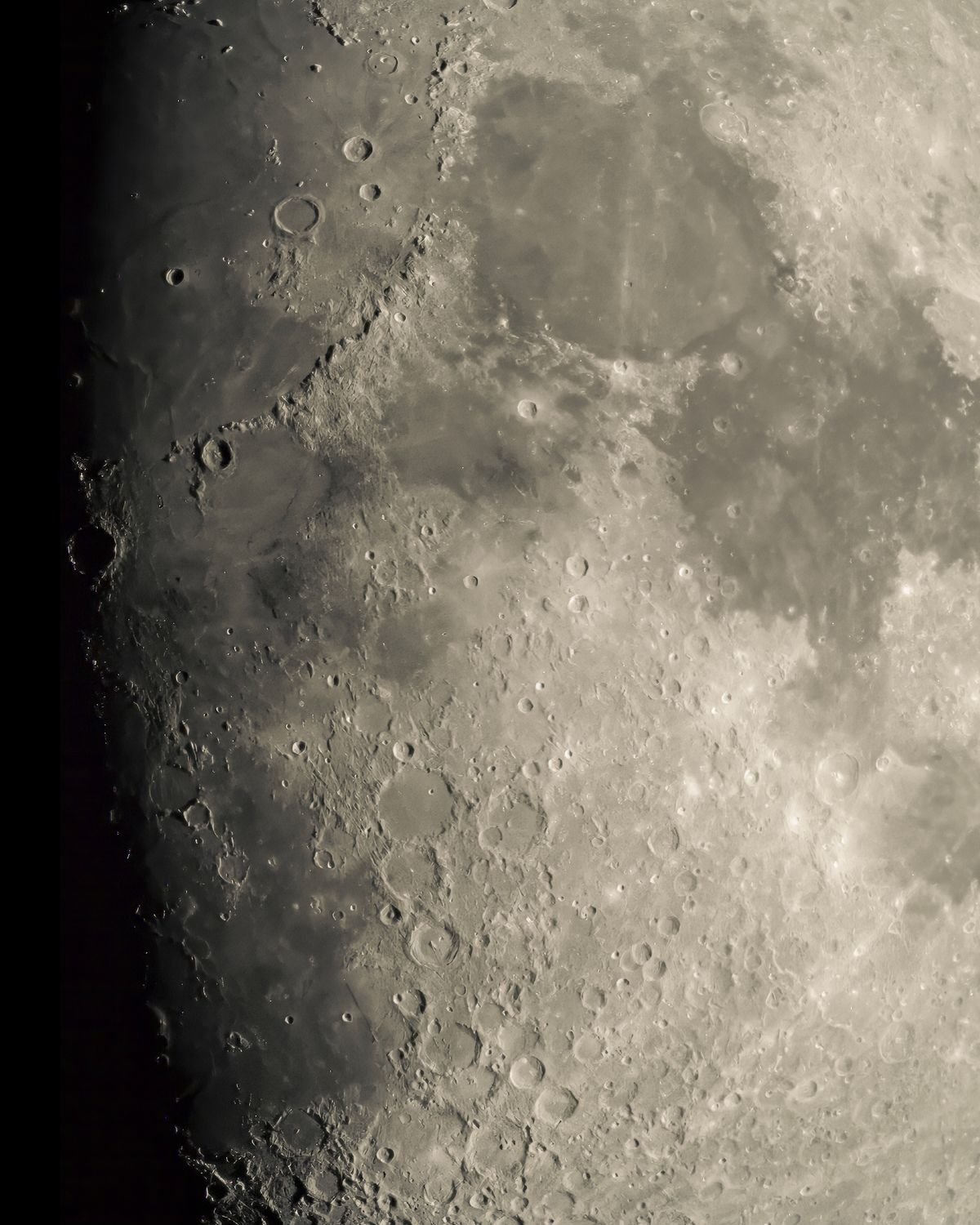
To explain the difference between mass and weight for objects on Earth and on the Moon, start with one simple idea: mass never changes, but weight does. Your mass is the amount of matter in your body. Your weight is the force of gravity pulling on that mass. On the Moon, gravity is about one sixth as strong as on Earth, so you would weigh about one sixth as much — but your mass would be exactly the same. This guide explains mass and weight in plain English, with the formulas, a worked example, and the mistakes students most often make in exams.
Mass and weight are confused in everyday life because we use the same word — weight — for both. Bathroom scales tell you your weight in kilograms, but kilograms are actually a unit of mass. In physics, the two are different quantities with different units, and the Moon is the perfect place to see why. Mass and weight are easily confused, which is why teachers explain the difference between mass and weight for objects on Earth and on the Moon in every physics class.
What Is Mass?
Mass is the amount of matter in an object. It is measured in kilograms (kg) in the SI system, and in grams (g) for small things. Mass does not depend on where you are. A 60 kg astronaut has a mass of 60 kg on Earth, on the Moon, in orbit, and in deep space. Nothing about the astronaut’s body changes when they travel. This definition is the starting point to explain the difference between mass and weight for objects on Earth and on the Moon.
Mass is also a measure of inertia — how hard it is to change an object’s motion. A heavy object is harder to push, stop and turn than a light one. That resistance is the same on Earth and on the Moon, because it comes from the mass itself, not from gravity. Inertia is the second idea to explain the difference between mass and weight for objects on Earth and on the Moon.
You measure mass with a balance, which compares an unknown mass with known masses. A beam balance works on the Moon exactly as it does on Earth, because gravity acts equally on both sides. That is a useful clue: if a measurement works the same on the Moon, it is measuring mass.
What Is Weight?
Weight is a force. It is the force of gravity acting on an object’s mass, and it is measured in newtons (N). On Earth, a 1 kg object weighs about 9.81 N. On the Moon, the same object weighs about 1.62 N, because the Moon’s gravity is weaker. The newton unit helps explain the difference between mass and weight for objects on Earth and on the Moon in calculations.
Weight depends on two things: the mass of the object, and the strength of gravity where it is. The formula is weight equals mass times gravitational field strength, written as W = mg. On Earth, g is about 9.81 newtons per kilogram. On the Moon, g is about 1.62 newtons per kilogram. These two factors explain the difference between mass and weight for objects on Earth and on the Moon more clearly than any definition alone.
You measure weight with a spring scale or a bathroom scale, which measures how much a spring is squeezed by gravity. A spring scale calibrated on Earth would give the wrong reading on the Moon, because the same mass squeezes the spring less in weaker gravity. That is another useful clue: if a measurement changes on the Moon, it is measuring weight.
Explain the Difference Between Mass and Weight for Objects on Earth and on the Moon: The Key Differences
Mass is a scalar quantity — it has size but no direction. Weight is a vector — it has size and a direction, always pointing toward the centre of the planet or Moon. Mass is measured in kilograms, weight in newtons. Mass is constant everywhere, weight changes with gravity. Mass is measured with a balance, weight with a spring scale. This scalar-versus-vector contrast helps explain the difference between mass and weight for objects on Earth and on the Moon.
Here is a quick comparison. Mass: what it is — amount of matter; unit — kilogram; changes with location — no; measured by — balance. Weight: what it is — force of gravity on mass; unit — newton; changes with location — yes; measured by — spring scale.
In everyday language, people say my weight is 70 kilograms. In physics, they should say my mass is 70 kilograms and my weight is about 687 newtons on Earth. Your teacher will understand the everyday phrase, but in an exam, use the correct terms. For a full reference, see the Wikipedia article on mass versus weight and the Physics Classroom guide to mass and weight.

Gravity on Earth and on the Moon
On Earth, the gravitational field strength g is about 9.81 N/kg. On the Moon, g is about 1.62 N/kg, which is roughly one sixth of Earth’s value. The Moon’s gravity is weaker for two reasons: the Moon has much less mass than Earth, and it is smaller, so its surface is closer to its centre — but the smaller mass dominates and gravity ends up weaker. The factor of six is a memorable way to explain the difference between mass and weight for objects on Earth and on the Moon.
NASA’s Moon missions gave us our best measurements of the Moon’s gravity. The Apollo astronauts could jump several times higher than on Earth, and dropped objects fell slowly. Their movements looked graceful and floating, and that was not a trick of the film — it was the physics of weaker gravity. You can explore the Moon’s gravity on the NASA Moon science pages and the main NASA website.
For comparison, Jupiter’s gravity is about 2.5 times Earth’s, so you would weigh two and a half times more there — if you could stand on its surface. In space, far from any planet, you are almost weightless, but your mass is unchanged. Weight is a local effect; mass is a property of the object itself.
Worked Example: A 60 kg Person on Earth and on the Moon
Take a person with a mass of 60 kg. On Earth, their weight is W = mg = 60 times 9.81 = 588.6 N, roughly 589 N. On the Moon, their weight is W = mg = 60 times 1.62 = 97.2 N, roughly 97 N. Their mass is 60 kg in both places.
Notice the ratio: 589 divided by 97 is about 6. The weight on the Moon is about one sixth of the weight on Earth, and the mass is unchanged. That ratio works for any object: a 10 kg rock, a 70 kg astronaut, or a 100 kg piece of equipment. Multiply the Earth weight by one sixth to get the Moon weight.
Here is another example. A bag of rice with a mass of 5 kg weighs about 49 N on Earth and about 8.1 N on the Moon. If you carried it on the Moon, it would feel very light. But if you tried to throw it, it would still be hard to accelerate, because its mass is the same — that is inertia, and it does not change with gravity.
Why Does Mass Stay the Same Everywhere?
Mass is the amount of matter in an object — the number of atoms and molecules, and how heavy each is. Travelling to the Moon does not add or remove atoms from your body, so your mass cannot change. Eating adds mass, losing water removes a little, but gravity itself does not affect mass at all. The constancy of matter helps explain the difference between mass and weight for objects on Earth and on the Moon in simple terms.
At very high speeds, mass can appear to increase in relativity, but at everyday speeds and in school physics, mass is constant. That is why exam questions about the Moon always ask for weight changes and expect you to say the mass stays the same.
One interesting fact: astronauts train for the Moon in water tanks and on special aircraft, because the feeling of low gravity is hard to reproduce. But their mass, and the effort needed to move heavy equipment, is the same as on Earth — the tools weigh less, but they are just as hard to stop once moving.
Common Mistakes Students Make
The most common mistake is to say that mass changes on the Moon. It does not. The second mistake is to give weight in kilograms. Weight is a force, so its unit is the newton. If a question gives you mass in kg, multiply by g to get weight in newtons.
The third mistake is to confuse weight with gravity. Gravity is the field; weight is the force the field applies to a mass. They are related by W = mg, but they are not the same thing.
The fourth mistake is to forget that g has different values on different bodies. Always check the question: it will give you g for Earth, the Moon, or another planet. Use the value in the question, not the one you remember. See Britannica for a clear overview of gravity and mass.
Mass and Weight in Everyday Life
You meet mass and weight every day. When you buy 2 kg of flour, you are buying mass. When you step on a bathroom scale, the scale measures your weight (the force) and converts it to kilograms for convenience. When a lift says maximum load 800 kg, it is really a mass limit, because the cable must support the weight that mass creates. Everyday examples like flour and medicine explain the difference between mass and weight for objects on Earth and on the Moon for most people.
In medicine, in cooking, in building and in sport, the difference matters. A dose of medicine depends on mass. A recipe depends on mass. A bridge is designed for weight. A rocket’s fuel is planned around mass. Learning the difference is not just for exams — it is how the world is measured.

Practice Problems
Problem one: a rock has a mass of 3 kg. What is its weight on Earth? Answer: W = mg = 3 times 9.81 = 29.4 N. On the Moon: W = 3 times 1.62 = 4.9 N.
Problem two: an astronaut’s weight on the Moon is 98 N. What is the astronaut’s mass? Answer: rearrange the formula, m = W divided by g = 98 divided by 1.62 = about 60 kg. On Earth, that astronaut would weigh 60 times 9.81 = 589 N.
Problem three: a gold bar has a mass of 10 kg. Its weight on Earth is 98 N, and on the Moon it is 16.2 N. Its value depends on its mass, not its weight, which is why gold is weighed by mass everywhere.
Frequently Asked Questions
Does my mass change on the Moon? No. Your mass is the amount of matter in your body, and it stays the same everywhere. Only your weight changes, because gravity is weaker on the Moon.
What is my weight on the Moon? Divide your weight on Earth by six. If you weigh 600 N on Earth, you weigh about 100 N on the Moon.
Why is weight measured in newtons? Weight is a force, and the newton is the unit of force. Kilograms measure mass, so weight cannot be in kilograms in physics.
Would I feel lighter on the Moon? Yes. You would be able to jump higher and carry heavy things easily. But objects would still be hard to start and stop moving, because their mass is unchanged.
Is gravity the same everywhere on the Moon? Almost, but not exactly. Gravity varies slightly with the terrain, and it is strongest in places with denser rock. The average value is 1.62 N/kg.
Conclusion
To explain the difference between mass and weight for objects on Earth and on the Moon: mass is the amount of matter, measured in kilograms, and it never changes. Weight is the force of gravity on that mass, measured in newtons, and it changes with gravity. On the Moon, where gravity is about one sixth of Earth’s, your weight is about one sixth of your Earth weight — but your mass is exactly the same. Remember the formula W = mg, use the right value of g, and the rest is simple arithmetic.
For more education guides from this site, visit the Decorator Advice homepage, browse our Education articles, and read our related guides: Explain What the Vertical Line Test Is and How It Is Used and Building Physic Master Programs in Italy. You can also test yourself with a Google search for mass vs weight Earth Moon to find more examples and worksheets.